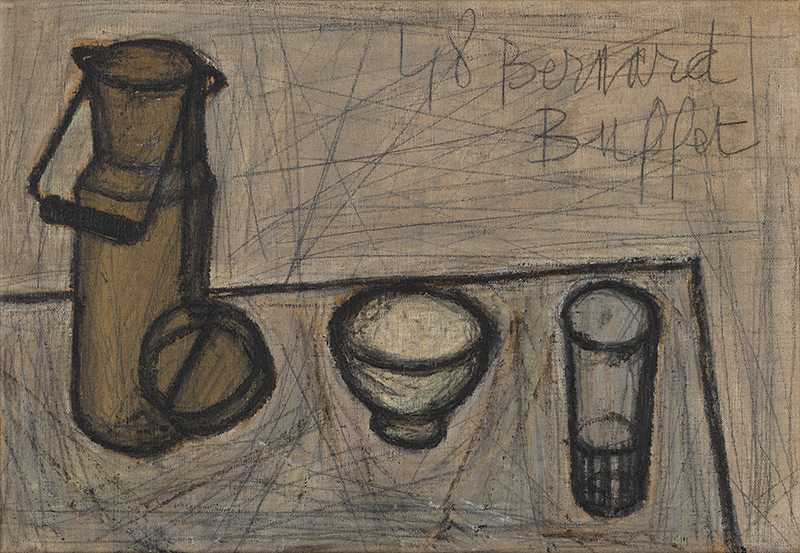
Nature morte au pot à lait, 1948
Oil and graphite on canvas, signed and dated upper right.
38 x 55 cm
Provenance :
Galerie David & Garnier, Paris
Collection of Henri-Georges Clouzot, Paris (acquired from the above between 1956 and 1968)
Christie’s, Paris, Collection Henri-Georges and Inès Clouzot, 1 December 2012, lot 2 (sale benefiting the Secours Catholique)
Galerie de la Présidence, Paris
Private collection, France
Literature :
Bernard Buffet, Catalogue raisonné, vol. 1, 1941–1953, Bernard Buffet Endowment Fund, 2019, illustrated p. 56.
Certificate of authenticity issued by Galerie Maurice Garnier.
There is little doubt as to the qualities that may have appealed to Henri-Georges Clouzot in Buffet’s early work. This master of mystery—often described as the “French Hitchcock” in light of his filmography and his dark obsessions—likely recognised in the painting of his younger contemporary the same sense of despair in the face of human nature.
He acquired this painting from the Galerie David et Garnier (between 1956 and 1968) and would never part with it, as the work later appeared in the sale of the collection of Henri-Georges and Inès Clouzot in 2012, held for the benefit of the Secours Catholique—many years after the filmmaker’s death.
At the time he painted this canvas, Buffet was barely twenty years old, yet he was already destined for a brilliant future. He had already exhibited at the Salon des Indépendants, sold his Nature morte au poulet to the Musée national d’art moderne, and attracted the attention of influential collectors as well as of a major gallery with which he would soon enter into an exclusive contract. That same year, he also exhibited at the Salon d’Automne and was awarded the Prix de la Critique (ex æquo with Bernard Lorjou). Recognition came swiftly to one who had embraced painting as an unwavering vocation.
At this period, Buffet’s work gives pride of place to still lifes : stripped-down tables, marked by a sense of deprivation that recalls how close the wartime shortages still were. In both palette and construction, these works are restrained. Even the paint itself is sparingly applied, lean, like the bodies that sometimes come to sit at these impoverished tables.
From Cézanne, Buffet borrows the idea of a simple corner of a table set with everyday utensils, the self-evidence of the ordinary.
From Cubism, he learns a form of geometric economy that never abstracts itself from reality, a sense of composition that leads to the very essence of the subject.
Run through with graphite lines—as if the paint, made even thinner than usual, allowed the underlying structure to show through—the canvas reveals the skeletal network of lines that the painter feels an urgent, almost furious need to cast onto the surface. This obsessive, graffitist impulse has not yet found a way to be channelled into the artist’s signature, his manifesto. Already, however, it consumes a large part of the pictorial surface, foreshadowing what it will become, though it has not yet attained its definitive form: that elongated, angular and assured line that would come to define a Buffet.
Buffet was on the verge of meeting Pierre Bergé, with whom he would live for eight years. His former companion would later turn away from him implacably, abhorring the painter’s stylistic evolution at the end of the 1950s. Bergé nevertheless carefully preserved within his collection still lifes from this earlier vein, such as Nature morte au fromage et au broc, dated 1949 (now in the collections of the Musée national d’art moderne, Centre Pompidou, Paris, through a dation: inv. AM 2022-733).